


R&D across health areas | Neglected Tropical Diseases
R&D for Neglected Tropical Diseases
How new tools can transform the fight
Neglected tropical diseases (NTDs) are a group of diseases that exert a crushing burden in poor and marginalized communities around the world, with women and girls often disproportionately affected. Named for the limited attention they have historically received, NTDs are inextricably linked to poverty and inequality. These diseases exact a heavy toll, causing chronic illness, severe disfigurement, blindness, and even death, and they can exacerbate malnutrition, delay cognitive development, and reduce economic productivity, entrenching affected populations in cycles of poverty. While increased attention in recent years has driven new resources and research breakthroughs, significant gaps remain in the arsenal of tools needed to control and eliminate these diseases, and climate change continues to expand vector-borne NTDs into new areas, underscoring the need for research and development (R&D) of new tools.
-
1 billion+ peopleworldwide are affected by NTDs
-
179 countriesreported an NTD in 2021
-
21 conditionsare classified as NTDs
 Research successes
New tools are advancing control and elimination of NTDs:
- Two breakthrough drugs for sleeping sickness, a fatal neurological disease, were approved in the past decade: fexinidazole in 2018-the first all-oral, 10-day cure replacing a two-week hospital IV regimen-and acoziborole in 2026-a single-dose oral cure that further simplifies treatment, which could accelerate progress toward elimination.
- Vimkunya, a single-dose vaccine for chikungunya, a disease that causes debilitating joint pain, that was initially developed by NIH was approved in 2025 for teens and adults.
- A dengue vaccine, Qdenga, that is safe for use in individuals with and without prior infection was approved in 2022, with a long-term trial showing that it offers seven years of sustained protection against infection and hospitalization.
- The first new drug for onchocerciasis in 20 years, moxidectrin, was approved in 2018 to treat this disfiguring and blinding disease.
- New combination regimens of existing drugs are improving care, including a triple-drug regimen for lymphatic filariasis-a disabling and disfiguring disease-that was recommended in 2017, and several shorter, more effective therapies for visceral leishmaniasis-a fatal disease that causes spleen and liver damage-which have been introduced in the last two decades.
- Child-friendly drugs for intestinal parasitic worm infections, Chagas disease, and schistosomiasis were approved or recommended in 2026 and 2024, 2011, and 2024, respectively, enabling children to receive appropriate care for these painful parasitic diseases. USAID backed development of one of two new formulations for parasitic worm infections.
- New diagnostics, including rapid tests for onchocerciasis and lymphatic filariasis, developed with NIH research, and a test that detects all four dengue types, developed by CDC, have been introduced.
- Mosquitoes infected with Wolbachia, a bacterium that blocks viral replication within mosquitoes, reducing transmission, have been released to fight dengue and other mosquito-borne diseases in select locations worldwide, protecting more than 16 million people. NIH and USAID funded research into this approach.
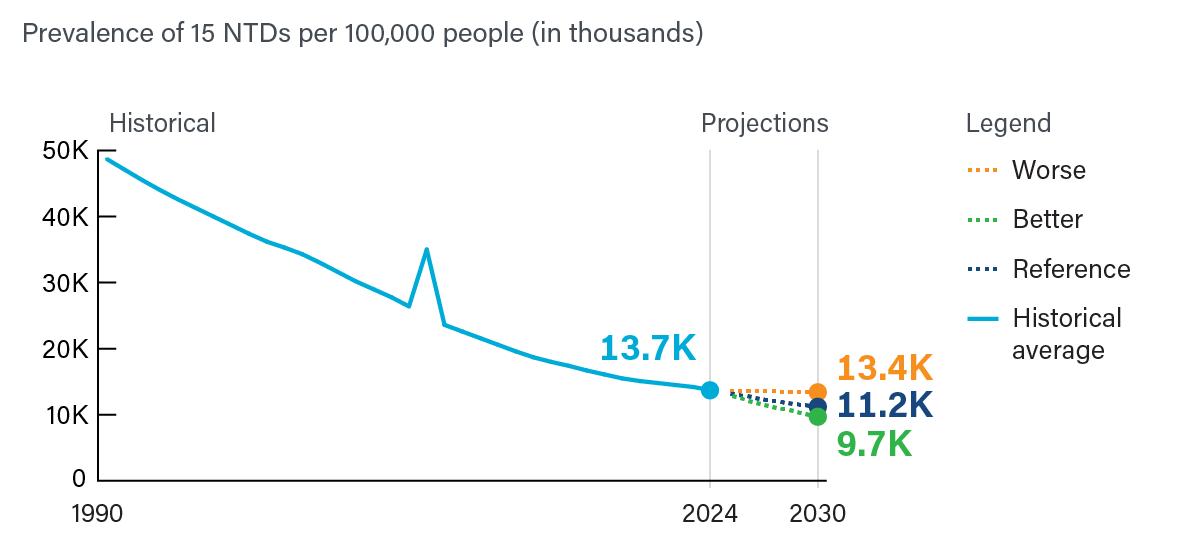
 Continued progress is possible, not inevitable
 Key missing tools
To eliminate NTDs, we need new and improved tools, including:
- New and improved diagnostics to rapidly detect infection at the point of care in low-resource settings-including distinguishing between different strains or stages of disease-and to confirm elimination as transmission declines; tests that detect NTDs in environmental and animal samples to strengthen surveillance; and multiplex tests that can detect multiple NTDs and similar infections using the same sample, supporting integration into primary health care.
- New and improved treatments and cures, including child-appropriate therapies and shorter, simplified regimens with fewer side effects. Although low-cost, effective interventions exist for some NTDs, many current treatments are still lengthy, burdensome, and poorly tolerated, and child-friendly formulations are often unavailable despite several NTDs disproportionately affecting children.
- Vaccines to prevent infection. Beyond dengue and chikungunya, no vaccines exist for the remaining NTDs prioritized by the World Health Organization.
- New vector and biological control tools, including space spray insecticides and approaches that disrupt reproduction, to reduce mosquito and other vector populations.
- Antivenoms to treat snakebites, including both broad-spectrum products effective against multiple snake species and targeted products for bites from specific high-risk species.
- Water, sanitation, and hygiene tools and infrastructure, including innovations that enable safe water access, sanitation, and hygiene in low‑resource settings, which are essential to interrupting transmission of several NTDs.
 Breakthroughs on the brink
- New shortened combination treatment regimens for Buruli ulcer, a chronic debilitating skin disease, are in the pipeline, including two treatments in Phase 2 trials that could cut treatment duration from eight weeks to just four.
- A repurposed veterinary drug is being evaluated in Phase 2/3 trials as a potential treatment for onchocerciasis and other parasitic worm infections; there are no cures for NTDs caused by parasitic worm infections, with current interventions mostly relying on mass drug administration in endemic areas.
- There is one vaccine for trachoma, a bacterial disease that can cause irreversible blindness, in the pipeline, which has shown promising results in a Phase 1 trial.
- A DoW-backed broad-spectrum rapid snakebite antidote, a first-of-its-kind treatment, has shown promise as an addition to antivenom for hospitalized patients in two Phase 2 trials and is being further evaluated in animal and human studies to establish the safety of a fully effective dose.
- Several vaccines for schistosomiasis-a disease that causes liver damage or kidney failure if left untreated-are in development, including an NIH-backed candidate in Phase 1 development and a NIH/DoW backed candidate now in Phase 2 trials.
- Two NIH-funded vaccine candidates against hookworm infection are in clinical development, including one in Phase 2 development. This parasitic infection causes gastrointestinal issues and protein deficiency and is linked to impaired learning in children.
- Point-of-care tests for Chagas disease, including for congenitally transmitted Chagas disease (the primary method of transmission in the United States), are being advanced with support from NIH.
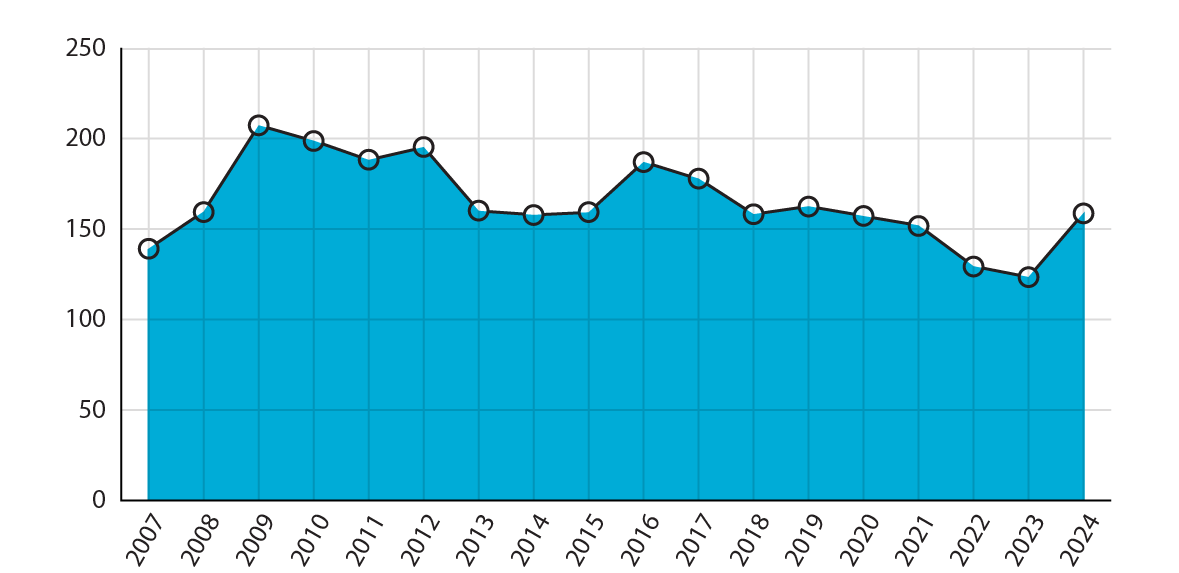
US government investment in NTD R&D, 2024 US$ millions
 US government R&D efforts
The US government is advancing R&D to control and eliminate NTDs through a whole-of-government approach:
- National Institutes of Health (NIH) conducts basic and clinical research for new treatments, vaccines, diagnostics, vector control products, and other tools to combat NTDs.
- Department of War (DoW) undertakes R&D to create vaccines, drugs, diagnostics, and vector control products for NTDs that threaten US service members stationed abroad.
- Centers for Disease Control and Prevention (CDC) advances research to develop new and improved diagnostics and interventions to strengthen NTD control and elimination efforts.
- Department of State absorbed the US Agency for International Development (USAID), which has historically supported the development of new drugs and diagnostics for a select group of NTDs and supported the rollout of existing interventions. The breadth of the State Department's ongoing work in NTDs remains unclear.
- Food and Drug Administration, alongside approving products for use in the United States, administers the Tropical Disease Priority Review Voucher Program to incentivize investment in products for NTDs.
Introduction
NTDs: World Health Organization. Neglected tropical diseases. Accessed February 20, 2026. https://www.who.int/health-topics/neglected-tropical-diseases#tab=tab_2
Climate change: World Health Organization. Global Report on Neglected Tropical Diseases 2025. World Health Organization; 2025. https://www.who.int/teams/control-of-neglected-tropical-diseases/global-report-on-neglected-tropical-diseases-2025
1 billion+ people affected: World Health Organization. Neglected tropical diseases. Accessed February 20, 2026. https://www.who.int/health-topics/neglected-tropical-diseases#tab=tab_2
179 countries reported: More countries eliminate neglected tropical diseases but investments key to sustain progress. Press release. World Health Organization; January 30, 2023. https://www.who.int/news/item/30-01-2023-more-countries-eliminate-neglected-tropical-diseases-but-investments-key-to-sustain-progress
21 conditions: World Health Organization. Neglected tropical diseases. Accessed February 20, 2026. https://www.who.int/health-topics/neglected-tropical-diseases#tab=tab_2
Research successes
Two breakthrough sleeping-sickness drugs, fexinidazole:
Drugs for Neglected Diseases initiative. Fexinidazole for T.b. gambiense. Updated February 21, 2025. Accessed February 20, 2026. https://dndi.org/research-development/portfolio/fexinidazole/
Drugs for Neglected Diseases initiative. Fexinidazole for T.b. rhodesiense. Updated February 21, 2025. Accessed February 20, 2026. https://dndi.org/research-development/portfolio/fexinidazole-tb-rhodesiense/
Two breakthrough sleeping-sickness drugs, acoziborole: Drugs for Neglected Diseases initiative. Acoziborole. Updated February 27, 2025. Accessed March 2, 2026. https://dndi.org/research-development/portfolio/acoziborole/
Dengue vaccine, approval: Cáceres M and Fisher BL. WHO prequalifies Takeda's Qdenga dengue vaccine. The Vaccine Reaction. May 28, 2024. Accessed February 20, 2026. https://thevaccinereaction.org/2024/05/who-prequalifies-takedas-qdenga-dengue-vaccine/
Dengue vaccine, long-term trial: New Phase 3 data show Takeda's dengue vaccine delivers 7 years of sustained protection against infection and hospitalization. Press release. Takeda; November 3, 2025. https://www.takeda.com/newsroom/newsreleases/2025/dengue-vaccine/
Chikungunya vaccine: Bavarian Nordic receives US FDA approval of chikungunya vaccine for persons aged 12 and older. Press release. Bavarian Nordic; February 14, 2025. https://www.bavarian-nordic.com/investor/news/news.aspx?news=7053
New drug for onchocerciasis: First new treatment for river blindness approved by US FDA in 20 years. Press release. World Health Organization Special Programme for Research and Training in Tropical Diseases; June 14, 2018. https://tdr.who.int/newsroom/news/item/14-06-2018-first-new-treatment-for-river-blindness-approved-by-u-s-fda-in-20-years
Combination regimens, lymphatic filariasis:
World Health Organization. Global Report on Neglected Tropical Diseases 2025. World Health Organization; 2025. https://www.who.int/teams/control-of-neglected-tropical-diseases/global-report-on-neglected-tropical-diseases-2025
Njenga SM, Kanyi H, Okoyo C, et al. Triple-drug therapy with ivermectin, diethylcarbamazine and albendazole for the acceleration of lymphatic filariasis elimination in Kenya: programmatic implementation and results of the first impact assessment. PLOS Neglected Tropical Diseases. 2024;18(7):e0011942. doi:10.1371/journal.pntd.0011942
World Health Organization. Lymphatic filariasis. Updated November 21, 2024. Accessed February 20, 2026. https://www.who.int/news-room/fact-sheets/detail/lymphatic-filariasis
Combination regimens, visceral leishmaniasis: Drugs for Neglected Diseases initiative. Visceral leishmaniasis: Projects & achievements. Accessed March 2, 2026. https://dndi.org/diseases/visceral-leishmaniasis/projects-achievements/
Child-friendly drugs, parasitic worms: Global Health EDCTP3. Ghana becomes first country to approve new combination of medicines to treat worm infections. Global Health EDCTP3. February 18, 2026. Accessed February 20, 2026. https://www.global-health-edctp3.europa.eu/news-and-events/news/ghana-becomes-first-country-approve-new-combination-medicines-treat-worm-infections-2026-02-18_en
Child-friendly drugs, parasitic worms, USAID: PQM+ celebrates WHO prequalification of malaria and NTD medicines. Press release. U.S. Pharmacopeia; August 30, 2024. https://www.usp.org/news/pqm-plus-celebrates-who-prequalification-of-malaria-and-ntd-medicines
Child-friendly drugs for Chagas disease: Drugs for Neglected Diseases initiative. Chagas disease: Paediatric Benznidazole. Accessed July 17, 2024. https://dndi.org/research-development/portfolio/paediatric-benznidazole/
Child-friendly drugs for schistosomiasis: The European Medicines Agency adopts positive opinion of our treatment option for schistosomiasis in preschool-aged children. Press release. Pediatric Praziquantel Consortium; December 15, 2023. https://www.pediatricpraziquantelconsortium.org/newsroom/european-medicines-agency-adopts-positive-opinion-our-treatment-option-schistosomiasis
Rapid tests for onchocerciasis and lymphatic filariasis: Innovative partnership brings to market new tools for neglected tropical diseases. Press release. PATH; April 11, 2016. https://www.path.org/our-impact/media-center/innovative-partnership-brings-to-market-new-tools-for-neglected-tropical-diseases/
Test that detects all four types of dengue: CDC begins distribution of new dengue fever tests. Global Biodefense. June 18, 2012. Accessed February 20, 2026. https://globalbiodefense.com/2012/06/28/cdc-begins-distribution-of-new-dengue-fever-tests/
Mosquitoes infected with Wolbachia, protected 16 million people: World Mosquito Program. Accessed February 20, 2026. https://www.worldmosquitoprogram.org/
Mosquitoes infected with Wolbachia, NIH support: US National Institutes of Health National Institute of Allergy and Infectious Diseases. Neglected tropical diseases scientific findings. Accessed July 17, 2024. https://www.niaid.nih.gov/research/neglected-tropical-diseases-scientific-findings
Mosquitoes infected with Wolbachia, USAID support: US Agency for International Development. Combating Zika and Future Threats: A Grant Challenge for Development. US Agency for International Development; 2021. Retrieved from: https://www.usaid.gov/sites/default/files/2022-05/2a_-_Lessons_Learned_on_Supporting_Crisis-Related_Innovations_-_MAY_2021_-_WMP_Success_Story_FINAL_1.pdf. Archived at: https://web.archive.org/web/20250201105614/https://www.usaid.gov/sites/default/files/2022-05/2a_-_Lessons_Learned_on_Supporting_Crisis-Related_Innovations_-_MAY_2021_-_WMP_Success_Story_FINAL_1.pdf
Continued progress is possible, not inevitable
Gates Foundation. Goalkeepers 2025 Report. We Can't Stop at Almost. Gates Foundation; 2025. https://www.gatesfoundation.org/goalkeepers/report/2025-report/
Key missing tools
General: World Health Organization. Global Report on Neglected Tropical Diseases 2025. World Health Organization; 2025. https://www.who.int/teams/control-of-neglected-tropical-diseases/global-report-on-neglected-tropical-diseases-2025
Gap in recommended child-friendly formulations: World Health Organization. Paediatric Research and Development Landscape for Neglected Tropical Diseases: Report on the 1999–2022 Period. World Health Organization; 2024. https://iris.who.int/server/api/core/bitstreams/7a33155f-9840-4e5e-bce7-34689d32dd4e/content
Antivenoms: World Health Organization. Target Product Profiles for Animal Plasma-Derived Antivenoms: Antivenoms for Treatment of Snakebite Envenoming in Sub-Saharan Africa. World Health Organization; 2023. https://www.who.int/publications/i/item/9789240074569
Water, sanitation, and hygiene: World Health Organization. Water, sanitation and health. Accessed April 13, 2026. https://www.who.int/teams/environment-climate-change-and-health/water-sanitation-and-health/burden-of-disease/wash-and-neglected-tropical-diseases
Breakthroughs on the brink
Shortened combination treatment regimens for Buruli ulcer:
Singh S, Yotsue R, Nuremberger E, Srivastava S. Repurposing drugs to advance the treatment of Buruli ulcer. Antimicrobial Agents and Chemotherapy. 2025;69(5):e00029-25. doi:10.1128/aac.00029-25
Beta-lactam containing regimen for the shortening of Buruli ulcer disease therapy (BLMs4BU). ClinicalTrials.gov identifier: NCT05169554. Accessed February 20, 2026. https://clinicaltrials.gov/study/NCT05169554#collaborators-and-investigators
New clinical trial examines use of novel compound telacebec in Buruli ulcer patients. Press release. TB Alliance; August 21, 2024. https://www.tballiance.org/news-new-clinical-trial-examines-use-novel-compound-telacebec-buruli-ulcer-patients/
Potential treatment for onchocerciasis and other parasitic worm infections:
Drugs for Neglected Diseases initiative. Emodepside. Updated February 21, 2026. Accessed February 20, 2026. https://dndi.org/research-development/portfolio/emodepside/
Drugs for Neglected Diseases initiative (DNDi). DNDi 2025 Projects of the Year recognize contributions of DNDi teams and partners working to deliver urgently needed innovations for people affected by Chagas disease and river blindness. DNDi. October 3, 2025. Accessed February 20, 2026. https://dndi.org/news/2025/2025-projects-of-the-year-recognize-contributions-teams-partners-working-innovations-chagas-disease-river-blindness/
Trachoma vaccine:
Pollock KM, Borges AH, Cheeseman HM, et al. An investigation of trachoma vaccine regimens by the chlamydia vaccine CTH522 administered with cationic liposomes in healthy adults (CHLM-02): a Phase 1, double-blind trial. The Lancet Infectious Diseases. 2024;24(8):829-844. doi:10.1016/S1473-3099(24)00147-6
Statens Serum Institut. Vaccine strategies to protect against trachoma tested in humans. Updated April 12, 2024. Accessed February 20, 2026. https://en.ssi.dk/news/news/2024/vaccine-strategies-to-protect-against-trachoma-tested-in-humans
Broad-spectrum rapid snakebite antidote: Ophirex. Working to revolutionize snakebite treatment. Accessed February 20, 2026. https://www.ophirex.com/varespladib-for-human-use/
Several vaccines for schistosomiasis: Infectious Disease R&D Tracker. Impact Global Health; 2025. Accessed February 20, 2026. https://www.impactglobalhealth.org/data/infectious-disease
Several vaccines for schistosomiasis, NIH-backed candidate: Jackson LA, Coler RN, Deye GA, et al. Safety and immunogenicity of the Sm-p80 GLA-SE schistosomiasis vaccine. npj Vaccines. 2025;10(247). https://doi.org/10.1038/s41541-025-01261-3
Hookworm vaccine candidates: Infectious Disease R&D Tracker. Impact Global Health; 2025. Accessed February 20, 2026. https://www.impactglobalhealth.org/data/infectious-disease
Hookworm vaccine candidate, Phase 2: Efficacy of Na-GST-1/Alhydrogel hookworm vaccine assessed by controlled challenge infection. ClinicalTrials.gov identifier: NCT03172975. Accessed February 20, 2026. https://clinicaltrials.gov/study/NCT03172975?intr=Na-GST-1%2FAlhydrogel%20hookworm%20vaccine&rank=1#collaborators-and-investigators
Point-of-care Chagas test: Kephera Diagnostics gets $3M NIH grant for Chagas disease test. 360Dx. March 31, 2023. Accessed February 20, 2026. https://www.360dx.com/infectious-disease/kephera-diagnostics-gets-3m-nih-grant-chagas-disease-test
Point-of-care Chagas test, congenital: Kephera Diagnostics wins $606K NIH grant to develop test for congenital Chagas disease. 360Dx. April 30, 2024. Accessed February 20, 2026. https://www.360dx.com/point-care-testing/kephera-diagnostics-wins-606k-nih-grant-develop-test-congenital-chagas-disease
US government investment in NTD R&D
G-FINDER data portal. Policy Cures Research; 2026. Accessed February 2, 2026. https://gfinderdata.policycuresresearch.org/
US government R&D efforts
KFF. The US government and Global Neglected Tropical Disease Efforts. KFF; 2024. https://www.kff.org/global-health-policy/fact-sheet/the-u-s-government-and-global-neglected-tropical-diseases/
US Food and Drug Administration. Tropical Disease Priority Review Voucher Program. Updated June 13, 2024. Accessed February 20, 2026. https://www.fda.gov/about-fda/center-drug-evaluation-and-research-cder/tropical-disease-priority-review-voucher-program