


Development of the first antiretroviral drugs and other subsequent therapies, which have collectively averted nearly 21 million AIDS-related deaths globally, and foundational science enabling a revolutionary new twice-yearly HIV prevention drug lenacapavir.
Global Health R&D across the US government | NIH
Global Health R&D at the National Institutes of Health
 What does NIH do for global health R&D?
The National Institutes of Health (NIH) advances basic, applied, and clinical research across a range of global health areas and products. NIH facilitates this research through in-house programs and grants to universities, nonprofits, and other organizations and operates clinical trial networks that serve as the backbone for clinical trials taking place across America and the world.
 Why is NIH’s role in global health R&D important?
NIH is the United States’ leading medical research institution and a major contributor to global health research. Through the National Institute of Allergy and Infectious Diseases, NIH advances research on global infectious diseases; through the Eunice Kennedy Shriver National Institute of Child Health and Human Development, it supports maternal and child health research; through the Office of AIDS Research and Office of Research on Women’s Health, it coordinates cross-cutting HIV/AIDS research and women’s health research and inclusion policies; and through the Fogarty International Center, it strengthens international research capacity. Together this work underpins the development of new drugs, vaccines, diagnostics, and other tools that save and improve lives worldwide.
 Impact of Investment
NIH support has helped advance at least:
46
new global health technologies approved since 1999*
217
promising products into late-stage development*
*Includes products for neglected diseases and emerging infectious diseases, except COVID-19.
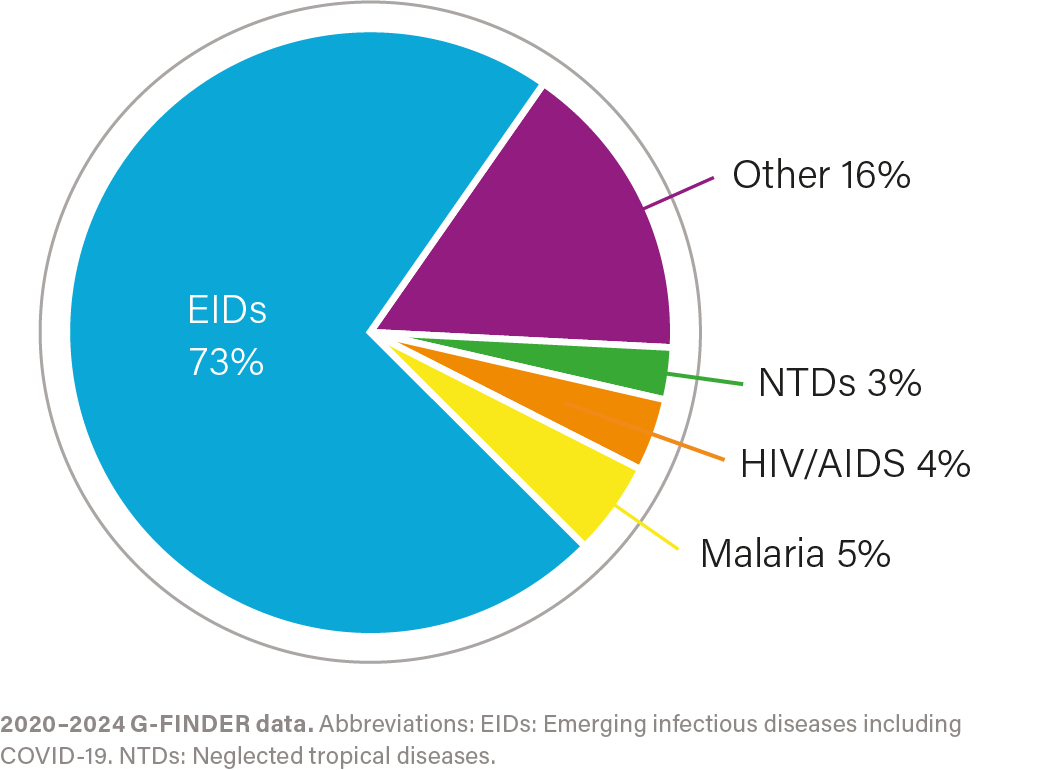
 R&D investment by health area, 2020–2024
R&D SUCCESS STORIES

HIV/AIDS

TB
Development of a new drug for drug-resistant tuberculosis (TB), pretomanid, which is part of new regimens that has transformed treatment outcomes and reduced treatment time and could lead to 191,222 additional lives saved and $1.29 billion in global cost savings by 2034.

NTDs
Development of new tools to combat neglected tropical diseases (NTDs), including two treatments for visceral leishmaniasis, a single-dose oral treatment for sleeping sickness, a single-dose chikungunya vaccine, and rapid diagnostic tests for Chagas disease and river blindness.

CAPACITY-STRENGTHENING
The Fogarty International Center has provided research training to more than 8,500 US and foreign scientists working in low- and middle-income countries, including alumni who have played vital roles in the Ebola, Zika, COVID-19, and HIV/AIDS responses.

GLOBAL HEALTH SECURITY
Advancement of key discoveries that led to the development of the mRNA vaccine technology that was successfully leveraged for COVID-19 vaccines and is being advanced for other disease threats, and development of both licensed Ebola Zaire vaccines and both licensed treatments.

WOMEN'S HEALTH
Pioneered discovery that led to first commercially available vaccine for HPV, which has protected millions around the world from cervical cancer, and supported development of a year-long, reusable contraceptive vaginal ring and a new first-in-class antibiotic for gonorrhea, a disease which can cause infertility and pregnancy complications.